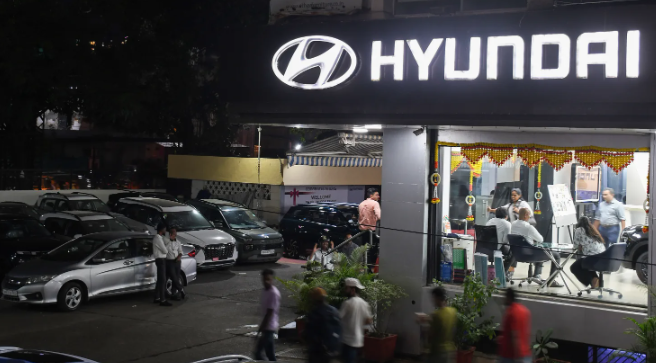
Shares of carmaker Hyundai’s Indian subsidiary started trading this week with much anticipation, only to drop by some 7% on its debut.
The stock has pared back losses since, but is still 5% below its initial public offering price.
The Korean car giant, the world’s third-largest passenger vehicle maker by volume, set up shop in India in 1996, soon after the country’s reforms to liberalize its socialist economy. Fast forward 28 years, and the company appears to have bagged its biggest payday yet by raising $3.3 billion from the stock market by offloading a 17.5% stake.
became India’s second-largest automaker by demonstrating that it understands the market by tailoring its globally popular and technologically advanced cars not only to Indian consumers’ tastes but also to its roads.
It’s a profitable enterprise, and Hyundai’s management believes this trend will continue.
Despite such success, it appears as if the stock market has given Hyundai the cold shoulder this week.
Shares have fallen across the board with the Nifty 50
index declining by about 5% over the past month. However, investors have pointed to several elements of the listing that might have also contributed to the immediate downturn.
First, the money raised by the stock market listing is being fed back to Hyundai’s Korean parent. In a typical IPO, however, money raised is used to invest in growth or pay down debt. Investors have balked at the idea that the Indian subsidiary won’t necessarily benefit from the cash raised on the stock market, nor has the Korean parent made it clear how it intends to use the proceeds of the share sale.
Second, it appears as if Hyundai doesn’t have an immediate need for the raised capital, and it’s merely being opportunistic by taking advantage of what some have called “frothy” markets in India.
“It’s not that the company needed money, so it’s really the parent trying to take advantage of the valuation,” said Gaurav Narain, principal advisor at the India Capital Growth Fund
, which is listed on the London Stock Exchange. The ICG fund primarily invests in Indian small and mid-cap stocks and did not participate in the IPO.
Kunjal Gala, head of global emerging markets and lead portfolio manager of the $3.3 billion Federated Hermes Global Emerging Markets Equity Fund, speculated the decision to list the Indian subsidiary could have been born out of a need for “a better valuation for their parent company in Korea.”
Gala’s fund holds stakes in other automakers such as Maruti Suzuki, India’s largest automaker, and China’s BYD. “So, this is one way of financially engineering a better valuation, right?”
With the listing, the Indian subsidiary now commands nearly half the market capitalization of its Korean parent.
Hyundai has also appeared to make up for any loss of future income from its share sale by hiking the royalty fees it charges its Indian subsidiary. Royalty fees were, until June, negotiated between the Indian entity and the Korean parent on a per-model basis. However, the Indian subsidiary must now pay a flat 3.5% of total revenue going forward.
Equity analysts at financial services company Emkay initiated stock coverage with a “sell” rating, citing reduced earnings potential thanks to the higher royalty payment, saying, “higher royalty, and lower treasury income are likely to restrict [earnings per share] growth.”
If that wasn’t sufficient, a number of investors and analysts suggest Hyundai priced the stock with minimal upside for a blockbuster IPO listing, a big turn-off for most retail investors. “What the retail investor wants is a big discount,” Narain added.
Others have, however, argued that investors sitting on the sidelines of one of India’s premier automakers are losing out on long-term gains.
“We believe [Hyundai Motor India] is a good proxy to play the rising premiumisation trend in the Indian car industry,” said Nomura’s analyst Kapil Singh in a note to clients on Oct. 22.
“More importantly, customers are increasingly becoming aspirational and willing to pay more for attractive designs and high-tech features.” Singh expects the stock to rise by about 32% from Thursday’s close to 2,472 Indian rupees ($29.40).
Analysts at Macquarie also agree that Hyundai is best placed to capture the changing face of India’s middle class and rich.
The investment bank also suggested that Hyundai India, thanks to its parent’s expertise and success in developing state-of-the-art hybrid and electric vehicles for Korean and Western markets, will be best placed to offer Indian consumers a superior product compared to its competitors when the time is right for the EV transition in India.