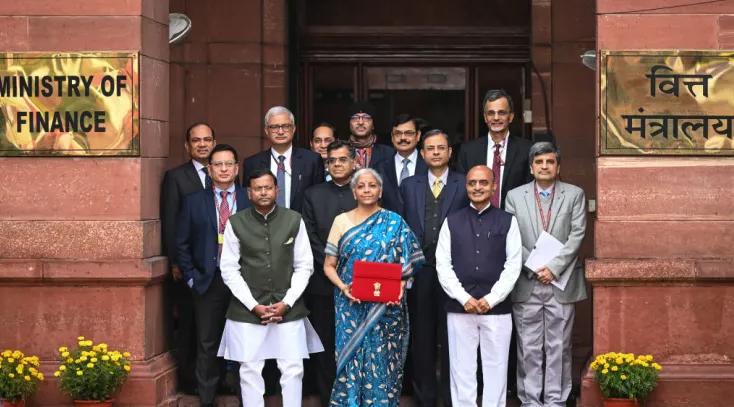
Indian Finance Minister Nirmala Sitharaman is due to present her seventh budget on Tuesday, which will provide clues on how Prime Minister Narendra Modi’s Bharatiya Janata Party will work with its allies to form a coalition government.
Expectations are high for a “populist” budget as recent election results showed a narrower-than-expected victory for Modi.
“The upcoming budget will be more important than in previous years as it will reflect whether the electoral setback will have any impact on the government’s policy direction and priorities,” Premal Kamdar, head of India equities at UBS Wealth Management, said in a research note to clients.
Modi has been forced to work with a number of small parties, one of which represents India’s poorest state of Bihar. The demands of the parties in this fragile coalition could mean the government will open the floodgates of welfare spending. This is likely to lead to increased borrowing.
However, Goldman Sachs analysts believe that is unlikely to be the case. “We are against both of those views,” said Santanu Sengupta, Goldman Sachs’ chief India economist.
They argue that policymakers may be addicted to the growth generated by infrastructure spending over the past few years and “may not be willing” to walk away from it.
Rather than increasing government borrowing, Sengupta and his team argue that the deficit could actually fall.
There is some evidence to support this view. Borrowing has fallen more than budgets typically target over the past four years. Bank of America analysts are also receptive to the idea that the deficit could fall, finding it “refreshing” to see the finance minister “underpromising and overdelivering.”
The government’s job of balancing the books has also been made easier by the Reserve Bank of India’s $25 billion check it wrote to the Indian government earlier this year. The central bank has a surplus because it holds more than $200 billion worth of U.S. Treasuries and other securities.
Where will the government spend the money?
Analysts on Wall Street are watching the political winds in New Delhi closely.
Many believe that income tax cuts are long overdue as income tax collections have risen from 2% of GDP pre-Covid to 3% by 2023. If left unchecked, they are expected to rise to 3.5% by 2025, Goldman Sachs estimates.
Besides individuals, the biggest beneficiaries of such rate cuts are likely to be companies in the consumer staples sector.
“Tactical opportunities could emerge in the consumer space if the government announces any consumer stimulus or increases tax exemption limits, thereby spurring consumer demand,” said UBS’s Kamdar.
Funds such as the Columbia India Consumer ETF, which holds stocks targeting consumer spending, have gained more than 22% this year on the theme, while the Nifty 50 benchmark index has risen 14% over the same period.
Over the past few months, seemingly sleepy large-cap stocks have suddenly rebounded. Hindustan Unilever, the listed unit of British multinational Unilever, is one such example, which has been touted as a way to trade the Indian budget. The company owns many brands in India such as detergents Cif and Domex, Magnum and Cornetto ice creams, Horlicks drinks, personal care products Dove, TRESemme and Vaseline, among others.
“Depending on the size and approach of the government’s stimulus package for rural India in the budget, Staples could see further upside,” Macquarie equity strategists led by Adity Suresh said in a note to clients last week.
“We believe that at current levels, HUVR (Hindustan Unilever) offers a better opportunity to capitalize on the potential uptick in rural demand from budget spending.”
Bank of America India economist Aastha Gudwani believes the government will further subsidize the country’s health insurance and manufacturing sectors to boost employment opportunities.
“To boost consumption, we expect effective tax cuts, increased subsidies on cooking gas, and interest rate subsidies for rural and urban housing,” Gudwani said.
“While this sounds like a lot of spending, we do not find the overall fiscal position troubling as the central government gets generous dividends from the RBI and other [central public sector undertakings].”