President-elect Donald Trump is less than a week away from being sworn in and has promised a flurry of activity from day one.
A key policy — one that worries global investors, yet is also seen as beneficial to India — has been Trump’s promise of stinging tariffs on all imports from China.
Economists expect India will benefit from a U.S.-China trade spat as American firms will attempt to diversify their supply chains.
“There are several ways in which this could all play out, but it is possible that India and Indonesia prove to be the biggest and most immediate winners from Trump’s tariffs – they do not appear to be in Trump’s crosshairs, have fairly low geopolitical risks, and have large and rapidly growing domestic markets,” said Shilan Shah and Marcel Thieliant of Capital Economics.
However, many analysts also forecast that U.S. manufacturing is unlikely to be revived due to tariffs alone. Instead, import taxes are likely to lead to a spike in inflation without economic growth – one that Trump will want to avoid.
“Trump has witnessed how corrosive inflation was to the Biden administration’s electoral support, and he’ll need a disinflationary offset to the inflation that may come from tariffs and immigration restrictions,” said Thierry Wizman, global FX and rates strategist at Macquarie.
Recent whispers from Washington suggest that tariffs are unlikely to be broad. Scott Bessent, hedge fund billionaire and Trump’s pick for Treasury Secretary is also expected to spell out his vision for U.S. trade policy today during his Senate confirmation hearing that reinforces the idea of targeted duties.
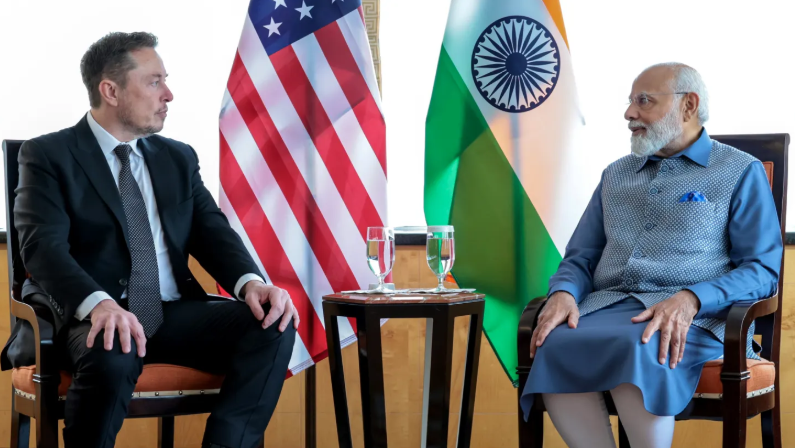
Yet, it’s another billionaire – Elon Musk – who is likely to have an outsized influence on America’s trade policy with China, which could be detrimental to India’s economic growth.
Musk, as the head of Tesla
, has enormous economic exposure to China through the automaker and will want trade policy between the two superpowers to be settled as soon as possible rather than let tensions rise.
While Musk isn’t alone in having business interests in China, he is among the future president’s inner circle of close advisors and could potentially play a crucial role in a U.S.-China trade deal.
“However, should a deal be brokered, the urgency to find an alternative would disappear as China remains more cost-competitive and boasts a full supply chain,” Narain added.
The Tesla chief has also been previously public about his gripe with India’s “highest in the world by far” tariffs on auto imports. Far from being supportive of India, Musk, now having Trump’s ear, could reignite trade tensions between India and the U.S. over India’s import duties.
In an attempt to woo Musk and also to partly deflect attention away from its own tariff policy, the Indian government temporarily lowered import duties for electric vehicles to 15% in 2024, after maintaining them at 100% over multiple decades.
However, economists suggest that Trump has surrounded himself with enough China hawks that even when a trade deal is struck, it will only lead to businesses delaying their transition out of China, rather than stopping it entirely.
“I think it just may be that the case of that investment coming [into India] slows because companies look at it and think, ‘Oh, we’ve got another four years’,” said Michael Langham, India economist at asset manager abrdn. “I don’t see companies thinking so short term as to not plan ahead for what is a longer-term trend, and that being the diversification of supply chains.”
Others also suggest that aside from trade tariffs imposed by Trump during his first administration, the Covid-19 pandemic has also contributed to the corporate strategy of moving away from China.